
Translated from the original Traditional Chinese post. Read the Chinese original →
I went to an ED antibiotics seminar (the ER & GIGS Joint Academic Symposium): four talks plus a new sedative. The whole time I was listening I had this feeling: the topics looked like they had nothing to do with each other (fever in chemo patients, cholangitis, complicated infections in the belly), but underneath they were all saying the same thing: if the source of infection isn't cleared, no matter how beautifully you pick the antibiotic, it's all for nothing.
When I got back I turned my notes into this post, and while I was at it I filled in a few concepts that usually get glossed over. I've tried to keep it plain so people still in training can read it too; whatever I could turn into a table, I did.
Let me be upfront first: this event was run by a drug company (TTY Biopharm), and the real star was an antibiotic called Brosym; all four talks were laying the groundwork for it. The content was solid, but when you see claims about which drug is better, remember to go back to the guidelines and your own hospital's resistance data before you decide.
Here's roughly how the four talks went:
| Session | Topic | The one line I remember |
|---|---|---|
| Opener | Byfavo: a new short-acting sedative | Fast on, fast off, stable BP, and it has a reversal agent |
| Stop 1 | Febrile neutropenia (FN) | Fever in a chemo patient is an emergency; give an antipseudomonal antibiotic within one hour |
| Stop 2 | Acute cholangitis | Two pillars, drugs and drainage; if the duct isn't open, antibiotics won't help |
| Stop 3 | Complicated intra-abdominal infection (cIAI) | What decides life or death is source control, not course length |
| Throughout | How to choose empiric antibiotics | Think three things: bug, drug, patient, then layer on your own hospital's resistance data |
Opener: a sedative called Byfavo
In the ED we often have to do procedures that hurt or need the patient to hold still, like reducing a dislocated joint, cardioverting an arrhythmia, placing a chest tube, or doing endoscopy. At times like these we give a sedative so the patient sleeps a bit, relaxes, and doesn't remember the pain much afterward. Our ideal sedative is basically fast on, fast off, doesn't drop the BP, doesn't suppress breathing, and ideally has a reversal agent to rescue you if something goes wrong.
Byfavo's generic name is remimazolam, an ultra-short-acting benzodiazepine (BZD, the sleeping-pill/sedative family). What makes it special is clearest when you put it next to two old drugs:
| Comparison | Byfavo (remimazolam) | Midazolam | Propofol (aka milk of amnesia) |
|---|---|---|---|
| Drug family | Ultra-short-acting BZD | Short-acting BZD | Non-BZD anesthetic sedative |
| How it's cleared | Broken down by tissue esterases, not liver or kidney dependent | Hepatic CYP450; accumulates if the kidneys are bad | Liver + whole-body metabolism, cleared fast |
| Time to sleep | About 1–3 minutes | 1–2.5 minutes | Fastest, about 30–60 seconds |
| Time to wake | Fast, predictable (about 10 minutes) | Slowest, can drag on 20–30 min | Fast |
| Effect on BP | Most stable, least hypotension | Fairly stable | Most likely to drop BP |
| Effect on breathing | Less respiratory depression, but it still happens | Yes | Most likely to suppress breathing |
| Injection pain | Almost none | None | Painful (its signature downside) |
| Reversal agent | Yes, flumazenil | Yes, flumazenil | No specific reversal agent |
| Status in Taiwan | Expensive, mostly self-pay, launched 2022 | Cheap, NHI-covered | Cheap, NHI-covered, most widely used |
Simply put, Byfavo is a sedative that keeps BP stable, doesn't hurt, and keeps a reversal agent up its sleeve, especially suited to patients who have bad hearts or lungs, are elderly, are on dialysis, or are very anxious. Its downsides are just as blunt: it's expensive, and it's self-pay.
For dosing, a physician at the event shared a little rule of thumb: reconstitute one 20 mg vial with 8 cc, which works out to exactly 2.5 mg per 1 cc. For induction, push 2 cc (5 mg) first, and if they're not asleep yet, give another 2 cc. It works much faster than midazolam; the patient is out in a minute and a bit. One reminder: BZDs don't provide analgesia on their own, so you still need to give the local anesthesia you'd normally give. One speaker mentioned a dialysis patient with a dislocated shoulder: a bit of Byfavo to relax the patient, and it went right back in, with BP and heart rate barely moving. With midazolam in the old days, patients would often take forever to wake up, and that bed would just be stuck.
Stop 1: Febrile Neutropenia (FN)
Chemo wrecks the bone marrow, and neutrophils (the main white blood cells that fight bacteria) drop very low. Once a patient like this gets infected, the body has almost no soldiers to contain the bacteria, which can storm into the bloodstream and kill within hours to days. So fever in a chemo patient is a red alert in the ED, not something you treat like a common cold.
When you take the history you must ask how many days ago the last chemo was, because the timing of FN is pretty consistent:
| Days after chemo | Neutrophils | What it means |
|---|---|---|
| Chemo given on day 0 | Still normal | — |
| Days 7–14 (most often 10–14) | Drop to the lowest point (nadir) | FN is most likely to show up in this window |
| Days 21–28 | Recover | Getting ready for the next cycle |
| Exceptions: BCNU/CCNU, mitomycin C, etc. | Delayed and prolonged (nadir at 3–6 weeks) | Can still be low weeks after chemo; don't miss it |
The diagnostic threshold is actually easy to remember: it's two things, fever plus low neutrophils:
| Item | Criterion |
|---|---|
| Fever | Single oral temp ≥ 38.3°C, or ≥ 38.0°C sustained for 1 hour or more |
| Neutropenia | Absolute neutrophil count ANC < 500, or expected to fall < 500 within 48 hours |
| Most dangerous | ANC < 100 (profound) |
The reason we get so worked up is backed by numbers. Roughly 8 out of every 1000 patients on chemo develop FN; once it happens, in-hospital mortality is about 10%, and about 20% have bacteremia. If the organism is Gram-negative, mortality can reach 18%.
When you get one of these patients, the first thing is to sort high vs low risk and decide whether to admit or whether they can go home on oral meds. The most commonly used tool is the MASCC score (max 26):
| Item | Points |
|---|---|
| No or mild symptoms (moderate 3, severe 0) | 5 |
| No hypotension (systolic BP > 90) | 5 |
| No COPD | 4 |
| Solid tumor, or hematologic malignancy with no prior fungal infection | 4 |
| No dehydration requiring IV fluids | 3 |
| Outpatient at onset of fever, not already inpatient | 3 |
| Age < 60 years | 2 |
There's one thing to be especially careful about with this score: in most ED scores, higher is worse, but MASCC is the opposite: higher is safer. ≥ 21 points is low risk, and you can consider oral or outpatient treatment; < 21 points is high risk, and the patient should be admitted for IV antibiotics.
Why it has to be an antipseudomonal β-lactam, and just one
This line is the core reasoning of the whole session, and it actually bundles three independent whys, each worth explaining one at a time:
| Why | |
|---|---|
| Why antipseudomonal | In someone with no immunity, Pseudomonas is a killer that can be fatal within hours; in the early days mortality was as high as 70%. Gram-positive organisms are more common now, but the cost of missing Pseudomonas is too high, so the very first dose has to cover it. |
| Why a β-lactam | These patients have no white cells to help clear bacteria; the drug has to kill the bacteria on its own, so you need a bactericidal agent, not a bacteriostatic one that only suppresses growth and waits for the immune system to finish the job. β-lactams happen to do it all: bactericidal, broad coverage, and antipseudomonal. |
| Why just one | It used to be popular to give a β-lactam together with an aminoglycoside (a drug that can damage the kidneys and ears). Later, large studies showed that monotherapy works just as well, with less toxicity. So unless the patient is very unstable, one drug is enough. |
In practice, the go-to drugs for high-risk inpatients are cefepime, piperacillin-tazobactam (everyone just calls it Tazocin), or a carbapenem; pick one and use it alone. Vancomycin is not a routine add-on; you only add it for unstable BP, suspected catheter infection, skin infection, or known MRSA colonization.
Taiwan's own data, plus two patients
Dr. 顏傑青 from the ED at Chang Gung Tucheng presented a Taiwanese study published this year (2026) by the NTUH team1, comparing Brosym, cefepime, and Tazocin for FN in patients with hematologic malignancies:
| Item | Result |
|---|---|
| Enrollment | NTUH 2021–2023, 159 FN episodes, 53 per group |
| Overall treatment success | 75.5% |
| By group | Brosym 79.2%, cefepime 71.7%, Tazocin 75.5%, no statistically significant difference |
| What actually predicted recovery | Not which drug was chosen, but whether neutrophils recovered by day 5 (adjusted OR about 3.3, 95% CI 1.15–9.63) |
What I found most interesting about this paper is that it reminds us of something from the other direction: in chemo patients, whether the bone marrow recovers matters more than which antibiotic you pick. On Taiwanese data, Brosym is no worse than the standard drugs and is a reasonable option, but it's still not the first choice in international guidelines.
The speaker closed with two patients, both of whom recovered. One was a 33-year-old man with B-cell lymphoma and hepatitis B carrier status who developed diarrhea and fever after chemo, with an ANC of only 94. In the ED he got Brosym, G-CSF, and fluids, and five days later his ANC went from 600 back to 3600 and he was discharged. The other was a 68-year-old man with head and neck cancer who developed fever and neutropenia after concurrent chemoradiation; after admission and antibiotics his ANC recovered, his CRP dropped from 153 to 11, and he was discharged without problems.
Stop 2: Acute Cholangitis
Bile flows from the liver through the bile ducts to the gut. If that pipe gets blocked by a stone or a tumor, bile stagnates and bacteria travel back up and multiply: that's cholangitis. There's a very important concept here: at the end of the day it's a clogged-pipe disease. Antibiotics alone to kill bacteria aren't enough; you have to open up the blockage, meaning drainage. So when we talk about treating cholangitis, it's always two pillars, antibiotics and drainage, and you can't do without either.
Diagnosis uses the Tokyo Guidelines (TG18)2, judged on three axes; in plain words: is there inflammation, is there bile obstruction, and do the ducts look different on imaging:
| Axis | What it covers | Threshold |
|---|---|---|
| A Systemic inflammation | Fever/chills, abnormal WBC or CRP | BT > 38°C; WBC < 4 or > 10; elevated CRP |
| B Cholestasis | Jaundice, elevated liver/biliary enzymes | Total bilirubin ≥ 2; ALP/γGTP/AST/ALT > 1.5× upper limit |
| C Imaging | Duct dilation or a visible cause | Ultrasound/CT shows dilated ducts, stones, or stricture |
A plus either B or C counts as suspected; all three counts as definite. By the way, the textbook Charcot triad (fever + jaundice + RUQ pain) actually has a sensitivity of only 20–30%; more than half of patients won't have all three. So don't wait for the full triad before you think of cholangitis; a cholestatic liver-enzyme pattern plus duct dilation is actually less likely to make you miss it.
Severity grading decides how fast you need to drain:
| Grade | In plain words | Criteria |
|---|---|---|
| 🔴 Grade III (severe) | Some organ is about to give out | Any one: needs vasopressors / altered mental status / poor oxygenation (PaO₂-FiO₂ < 300) / creatinine > 2.0 / INR > 1.5 / platelets < 100,000 |
| 🟡 Grade II (moderate) | In between, lots of warning signs | Any two of: WBC > 12,000 or < 4,000 / fever ≥ 39°C / age ≥ 75 / total bilirubin ≥ 5 / low albumin |
| 🟢 Grade I (mild) | Meets none of the above | — |
Easy way to remember it: Grade III only needs one organ in trouble; Grade II needs two items.
Timing of drainage follows the grade:
| Grade | Timing of drainage |
|---|---|
| 🔴 Grade III | Urgent: stabilize BP and breathing first, then ERCP or PTBD as soon as possible |
| 🟡 Grade II | Early: within 24 hours works best |
| 🟢 Grade I | Conservative first; if no response in 24 hours, treat as Grade II |
The numbers are convincing too: for moderate cholangitis, drainage within 24 hours gives a 30-day mortality of 1.7%, versus 3.4% if it's delayed past 24 hours, double. And since ERCP became widespread, cholangitis mortality has fallen from around 50% in the past to under 10% now.
How do you choose the antibiotic? The rule is that you must cover gut Gram-negative organisms (E. coli, KP); the sicker the patient and the more it looks hospital-acquired, the broader you go. Patients with a prior biliary-enteric anastomosis need additional anaerobe coverage. Drugs that reach high concentrations in bile, like cefoperazone (the main component of Brosym), are naturally a good fit for biliary infections.
Dr. 陳介章 presented their own team's multicenter study, made public for the first time this year3, comparing Brosym with Flomoxef:
| Item | Details |
|---|---|
| Enrollment | Six hospitals, 389 patients (Brosym 249 vs Flomoxef 103; the two arms add up to 352, and the gap from the total is to be confirmed), mostly community-acquired, Grade I/II |
| Clinical response on day 4 | Brosym 96–97%, Flomoxef 93%; after adjustment Brosym slightly ahead |
| Day 7 | The gap between the two narrowed |
| Safety | Adverse reactions 2–5%; PT prolongation with Brosym 2.4%; no major bleeding |
The point is that Brosym's early response is fast, which makes it a good choice in the ED when you want to stabilize quickly and get the patient discharged sooner.
Stop 3: Complicated intra-abdominal infection (cIAI): source control decides life or death
For infections inside the belly (perforation, abscess, anastomotic leak), the most critical treatment is clearing the source: draining the abscess, repairing the perforation, cutting out necrotic tissue, pulling infected tubes. Antibiotics actually come second. This has a name: source control. If it isn't cleared, even the broadest antibiotic won't save them; this line got repeated over and over at this stop.
Dr. 郭庭均 from NTUH used a single patient to tie all the concepts together, and I thought it was the best part of the whole event:
A 62-year-old man with distal cholangiocarcinoma causing obstructive jaundice. The original plan was to drain the bile first and then do curative surgery. The first step was ERCP, but drainage failed, so they switched to EUS-HGS: using endoscopic ultrasound to punch a channel from the stomach wall into the intrahepatic bile duct and placing a stent to drain bile into the stomach. Right after the procedure the patient was fairly stable. But eleven days later he suddenly had severe abdominal pain and fever, and CT showed a big collection of biloma between the liver and the stomach. His inflammatory markers shot way up, and the whole thing turned into a complicated intra-abdominal infection with septic shock.
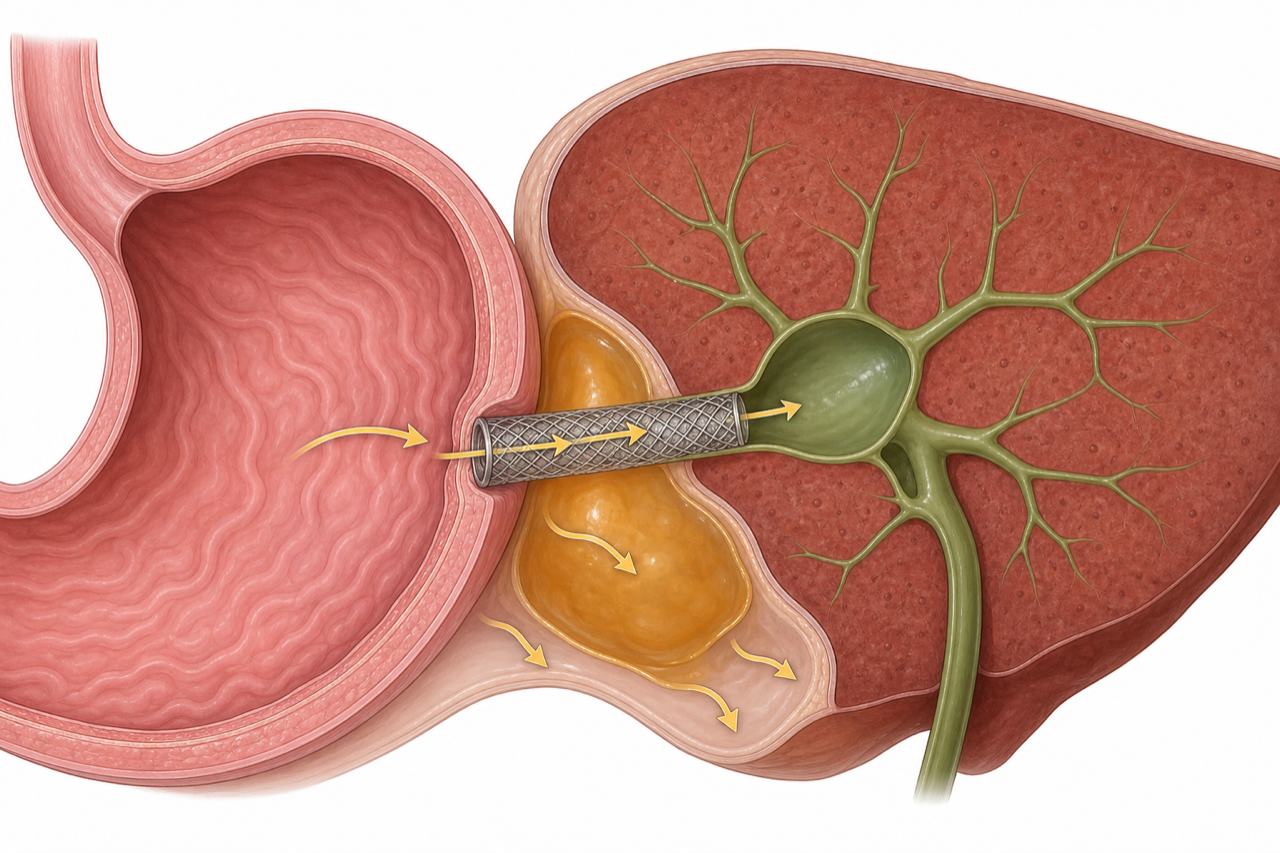
Figure: EUS-HGS connects the stomach to the intrahepatic bile duct (green) with a stent to drain bile; once bile leaks beside the stent and collects into a biloma (amber), bacteria from the stomach and upper GI tract follow the arrows into the peritoneal cavity, and it becomes an intra-abdominal infection.
Why does this happen? Because EUS-HGS essentially opens an artificial channel between the stomach and the biliary tree. Once bile leaks beside the stent and collects into a biloma, bacteria from the mouth and upper GI tract travel along that path into the belly. This is called bacterial translocation, and sure enough, blood cultures later grew viridans Streptococcus, a common oral organism, which fit perfectly. Management was doing two things at the same time: placing a drain to clear the biloma (source control) while giving empiric antibiotics (Brosym). His inflammatory markers came all the way back to normal, and the patient later went on to complete his curative surgery.
There are three takeaways from this case. If a patient who's had EUS-HGS develops fever and abdominal pain after the procedure, think biloma and peritonitis first, because that artificial channel is a highway for bacteria. Drainage and antibiotics also have to happen together; you can't do one, see if it fails, and then do the other. As for cultures, their job is de-escalation only; you can't wait for them to decide whether to start treatment. I'll expand on this below.
As for how long to give antibiotics, a classic large trial, STOP-IT (NEJM 2015)4, gave the answer: once the source is controlled, a fixed 4 days of antibiotics, compared with continuing until symptoms resolve (median 8 days), made no difference in complications or mortality. With the source taken care of, prolonging antibiotics brings no extra benefit. When a patient isn't getting better, the first question to ask is has the source been controlled?, not whether the antibiotics have run long enough.
Throughout: how to choose empiric antibiotics
Culture results take two or three days, but septic patients can't wait. So we start a somewhat broad antibiotic based on the most likely organisms; that's called empiric treatment. To use a target-shooting analogy, empiric treatment is firing first, then going back to adjust your sights once the cultures come back.
So what makes a good shot? The speaker laid it out very clearly; it really comes down to these few things:
| Criterion | What it means |
|---|---|
| Right | Cover the most likely and the most lethal organisms, and get the coverage right with the very first dose |
| Early | If you suspect septic shock, give the drug within one hour |
| Adequate | Enough dose, and the drug has to actually reach the site of infection |
| Safe | Account for allergies, liver and kidney function, and toxicity |
| Narrow, de-escalatable | Don't go ultra-broad for no reason; de-escalate once cultures are back |
| Paired with source control | Even the best drug is useless if the source isn't cleared |
Flip it around: why does empiric treatment fail? When the patient isn't improving, go down this list, and for surgical infections always think of the first one first:
| Cause | In plain words |
|---|---|
| Source not cleared | Abscess not drained, perforation not repaired, bile duct still blocked |
| Organism not covered | Resistant organisms (ESBL, MRSA, Pseudomonas, Acinetobacter) not covered, or it isn't bacterial at all |
| Drug can't get there or dose is too low | Abscess, blocked biliary tract, blood-brain barrier; sepsis also throws off the pharmacokinetics |
| Host can't clear it | Severely immunocompromised, foreign body or biofilm, necrotic tissue |
Two terms here are worth explaining on their own.
One is ESBL (extended-spectrum β-lactamase). Some bacteria make an enzyme that just takes apart a whole lot of antibiotics. What really makes it a headache isn't just the word resistance; it's that this resistance gene is often bundled with other resistances, so when one drug falls, the backup drugs fall with it, and it has already spread from hospitals into the community. So for serious ESBL bloodstream infections, carbapenem is still the first choice.
The other is the inoculum effect, meaning that when there are too many bacteria, the same antibiotic can suddenly stop working, because the more bacteria there are, the more drug-destroying enzyme there is, and the drug gets overwhelmed.
| Setting | Bacterial load | Antibiotic effect |
|---|---|---|
| Standard culture-plate testing | Low | Tests as effective |
| A real abscess or large fluid collection | Extremely high, possibly tens of thousands of times more | The drug is overwhelmed and may actually be ineffective |
This is actually another pharmacologic reason for source control: drainage and debridement cut the bacterial load down, and that's what makes the antibiotic effective again. Uncleared source, failed antibiotics isn't just a slogan; it has a pharmacologic basis.
Back to cultures. They serve three purposes, none of which is deciding whether to start treatment: confirming whether you got the coverage right in the first place; de-escalation (the most important one: once you know the exact organism, switching to a narrower drug means a bit less resistance, a bit less C. diff, and a bit less cost); and switching drugs if you guessed wrong. One more reminder: in biliary and intra-abdominal infections, bile or pus cultures have a much higher positive yield than blood cultures, so always remember to send them when you drain.
One last very practical reminder: every hospital's bugs are different. Even for the same cholangitis, the common organisms and resistance patterns differ between this hospital and that one, and between the ICU and the general ward. So guidelines can only give you an opening move; the real right answer is your own hospital's resistance report (antibiogram). That's also why Taiwan needs to do its own local studies rather than copy Western recommendations wholesale.
The star of the event: Brosym (cefoperazone / sulbactam)
I've kept mentioning Brosym, so let me explain it on its own here. It's a combination of two components: cefoperazone (a third-generation cephalosporin that is antipseudomonal on its own) plus sulbactam.
Why add sulbactam? Because it does two jobs by itself:
| Sulbactam's role | What it's doing |
|---|---|
| Protective umbrella | Cefoperazone is easily broken down by bacterial drug-destroying enzymes (β-lactamases); sulbactam blocks those enzymes, effectively rescuing cefoperazone, and along the way adds ESBL and anaerobic coverage |
| A weapon in its own right | Sulbactam itself kills Acinetobacter (Acinetobacter baumannii), which is the key reason it's popular for hospital-acquired infections in Taiwan |
Note that the antipseudomonal activity is entirely cefoperazone's doing; sulbactam contributes nothing against Pseudomonas.
Here's its spectrum, summarized:
| Category | Coverage |
|---|---|
| Gram-negative (strength) | E. coli, KP, Enterobacter, Proteus, Pseudomonas, Acinetobacter |
| ESBL producers | Yes (thanks to sulbactam) |
| Gram-positive | Streptococcus, MSSA (methicillin-sensitive Staphylococcus aureus): moderate; Enterococcus unreliable, no MRSA coverage |
| Anaerobes | Bacteroides, moderate, about 67% |
| Not covered | MRSA, VRE (vancomycin-resistant Enterococcus), atypicals, CRE (carbapenem-resistant Enterobacterales) |
There's one side effect you have to remember: it affects coagulation. Cefoperazone has an NMTT side chain that interferes with vitamin K–dependent clotting factors, which can prolong PT/INR and even cause bleeding:
| Key point | Details |
|---|---|
| Mechanism | The NMTT side chain inhibits vitamin K, so clotting factors can't be made; on top of that, a broad-spectrum antibiotic also kills the gut bacteria that help produce vitamin K |
| Actual incidence | In Taiwanese studies, PT prolongation about 2–4% and bleeding about 2%, similar to other drugs, and reversible |
| Who needs caution | Poor nutrition, courses longer than a week, the elderly, renal or hepatic impairment, biliary obstruction (vitamin K absorption is already poor), thrombocytopenia |
| What to do | Monitor PT/INR, give vitamin K if needed, no alcohol during treatment (disulfiram reaction) |
While we're here, a very practical question someone asked on the spot: if we give Brosym in the ED, will it affect invasive procedures or surgery that GI or surgery want to do afterward? The experts' answer was that a single dose has almost no effect, because the clotting problem usually only becomes noticeable after more than a week of use, and ERCP is generally done within a day or two. No need to delay for it; routine PT monitoring is enough.
Do you need to adjust the dose for poor renal function?
If you do adjust, the key is sulbactam (renally excreted, accumulates), not cefoperazone (biliary excretion). The package insert recommends reducing the dose by renal function:
| Creatinine clearance CrCl | Maximum daily dose |
|---|---|
| > 30 | 4 g / 4 g (2 g/2 g every 12 hours) |
| 15–30 | 2 g / 2 g (1 g/1 g every 12 hours) |
| ≤ 15 | 1 g / 1 g (0.5 g/0.5 g every 12 hours) |
That said, Taiwanese research in recent years has actually challenged the package-insert dose reduction. A 2022 study from the Chi Mei team5 (Antibiotics) compared 155 patients with chronic kidney disease: one group got a fixed 2 g/2 g twice a day, not reduced for renal function, and the other was dose-reduced by renal function. The result: the non-reduced group actually had a higher treatment success rate (80% vs 65%), and no more side effects like bleeding or PT prolongation. The package-insert reduction scheme looks more like a conservative regulatory convention; clinically, keeping the higher dose may be more effective and just as safe. That's also what an ID physician on the symposium panel said: you really don't need to adjust the dose, it's just too much hassle to change the package insert. Of course, these are data from a CKD population, and for dialysis patients you still have to judge case by case. (Also remember one trap: because it's a fixed 1:1 combination, once you reduce the dose, cefoperazone gets cut along with it, and the antipseudomonal dose may no longer be enough.)
How Brosym and Flomoxef differ
Finally, let's put it next to Flomoxef, which it often gets compared with:
| Aspect | Brosym (cefoperazone/sulbactam) | Flomoxef (Flumarin) |
|---|---|---|
| Antipseudomonal | ✅ Covers | ❌ Doesn't cover (the biggest difference) |
| Acinetobacter | ✅ | ❌ |
| ESBL | ✅ | ✅ (inherently stable against ESBL) |
| Anaerobes | Moderate | ✅ More reliable |
| Bleeding risk | Yes, keep an eye on it | Lower |
| Best fit | Need antipseudomonal coverage, hospital-acquired infection, FN | Community-acquired, no need for antipseudomonal coverage, want to spare carbapenems |
The key difference is antipseudomonal coverage. Because Flomoxef doesn't cover Pseudomonas, it can't be used as empiric monotherapy for FN, which would break the principle from earlier that it has to be antipseudomonal.
Finally, one line to take home from the whole event
The session chair, Dr. 李智晃, wrapped up with a very memorable rule: when choosing antibiotics, always think of three things, the bug (what organisms you'll face), the drug (which drugs work), the patient (whether their liver, kidneys, and comorbidities call for adjustment).
And the real main theme of the whole event is the line stated at the very start and confirmed again and again afterward: what decides life or death is source control, the direction is set by the local bugs, empiric antibiotics have to be both early and accurate, and course length doesn't affect survival. Complicated intra-abdominal infection has never been something surgery alone can solve; surgery, endoscopy, interventional radiology, and antibiotics, you can't do without any of them.
This post is my personal study notes from a public academic symposium, and it includes drug-company-sponsored product presentations. For all drug choices, doses, and interpretation, go by the latest clinical guidelines, the package insert, and your own hospital's resistance data, with decisions made by the attending physician based on each patient's situation.
References
Tsai M-T, Chuang Y-C. Cefoperazone-sulbactam versus cefepime and piperacillin-tazobactam for initial empiric treatment of febrile neutropenia in patients with hematologic malignancies: a retrospective matched-cohort study. J Microbiol Immunol Infect. 2026. doi:10.1016/j.jmii.2026.06.001 (PubMed PMID 42270532) ↩︎
Kiriyama S, et al. Tokyo Guidelines 2018: diagnostic criteria and severity grading of acute cholangitis. J Hepatobiliary Pancreat Sci. 2018;25(1):17-30. doi:10.1002/jhbp.512 | Gomi H, et al. Tokyo Guidelines 2018: antimicrobial therapy for acute cholangitis and cholecystitis. J Hepatobiliary Pancreat Sci. 2018;25(1):3-16. doi:10.1002/jhbp.518 ↩︎
陳介章 et al. A multicenter comparative study of cefoperazone-sulbactam vs flomoxef for acute cholangitis (six hospitals, 389 cases). Oral presentation, 2026 ER & GIGS Joint Academic Symposium; formal publication details to be confirmed. ↩︎
Sawyer RG, et al. Trial of short-course antimicrobial therapy for intraabdominal infection (STOP-IT). N Engl J Med. 2015;372(21):1996-2005. doi:10.1056/NEJMoa1411162 (PubMed PMID 25992746) ↩︎
Chao C-M, Lai C-C, Lee C-H, Tang H-J. Optimal dose of cefoperazone-sulbactam for acute bacterial infection in patients with chronic kidney disease. Antibiotics (Basel). 2022;11(5):610. doi:10.3390/antibiotics11050610 (PubMed PMID 35625254) ↩︎


Thoughts on this case? Leave a comment, a like, or a reaction below.
comments powered by Disqus