Translated from the original Traditional Chinese post. Read the Chinese original →
Whole-'Heart'-ed
Thread by @shahrukh_bakar on Thread Reader App
An interventional cardiologist replied to a case posted by someone on Twitter. This patient was delayed for 10-plus hours before finally getting PCI. Over those 10-plus hours, the patient's chest pain kept waxing and waning.
The cardiologist pulled together some key concepts for patients like this one (Non-STEMI, waxing-and-waning chest pain, delayed cath). I found it really practical.
My rough translation, plus my own notes from studying ECGs:
- No matter what the ECG looks like, ongoing chest pain is a major Red flag sign➡cath lab immediately, no delay
- A Q wave does not mean there's no viable myocardium; Q waves can also be a very early finding in ischemia
Key points on Early Q waves
- In one study of STEMI patients, all treated within 12 hours, myocardial salvage still mattered a lot in patients with Early Q waves. The main finding was that patients with STEMI/Early Q waves (even though transmural, irreversible myocardial damage was presumed) still had a better prognosis after ART➡so patients within 12 hours with STE + Early Q waves should not be excluded from PCI
- In Ant.wall STEMI, 50% develop Q waves within 1 hour➡this does not mean a late or subacute MI
Hypokinesis/akinesis does not mean the myocardium is non-viable➡it may be myocardial stunning
Ischemia of just 20% of wall thickness is enough to cause RWMA
Sitting next to a patient with ongoing chest pain, delaying the cath gets you nothing at all
Giving opioids to a patient with ongoing chest pain may mask the ongoing pain➡use NTG first
On using Morphine
This is also mentioned in this post on Smith's ECG blog (in my own words):
Be careful not to give morphine to NonSTEMI patients, because it will mask ongoing chest pain and delay getting them to PCI. Only give opioids once the CV man has already agreed to take the patient for PCI (e.g., STEMI)
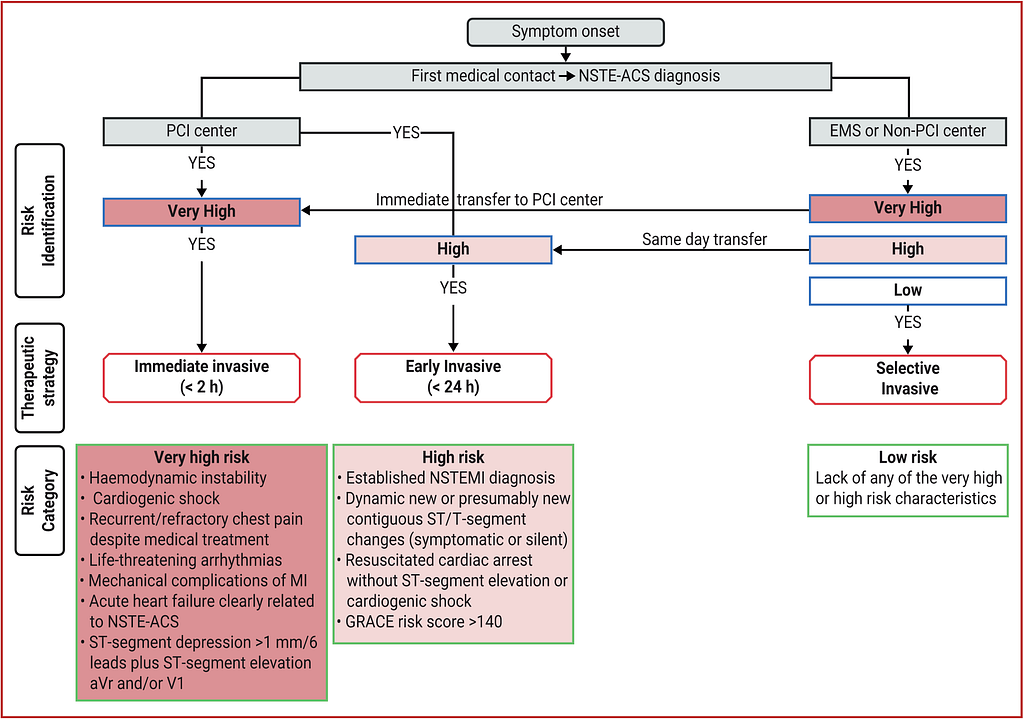
- If NTG doesn't relieve the pain and a very high risk situation shows up➡immediate PCI
What counts as a very high risk situation➡PCI within 2 hours
See the dark red box in the lower left of Fig 1 (From ESC 2020 NonSTEMI guideline)?
- Hemodynamic instability
- Cardiogenic shock
- Ongoing chest pain despite medical therapy
- Life-threatening arrhythmias (VT/Vf)
- Mechanical complications after MI
- Acute HF caused by AMI
- aVR and/or V1 STE + Multiple leads STD
When a patient with ongoing chest pain doesn't get an early call to the CV man and only gets a delayed PCI later, we really need to do a systematic review of which link in the chain broke
No ST elevation does not equal no need for PCI. Unfortunately, some people still hold on to this mindset, and it has caused patients irreparable harm.
Don't be reassured by spontaneous resolution of chest pain; any pain >0/10 can be a problem, and even >50% STE resolution after rtPA can still be a problem. To say it again: any chest pain that shows no improvement at all with NTG needs PCI considered
Spontaneous reperfusion does not mean the vessel is fully open; however much it has opened, it still needs PCI, because it can occlude again at any moment
Thoughts on this case? Leave a comment, a like, or a reaction below.
comments powered by Disqus