Translated from the original Traditional Chinese post. Read the Chinese original →
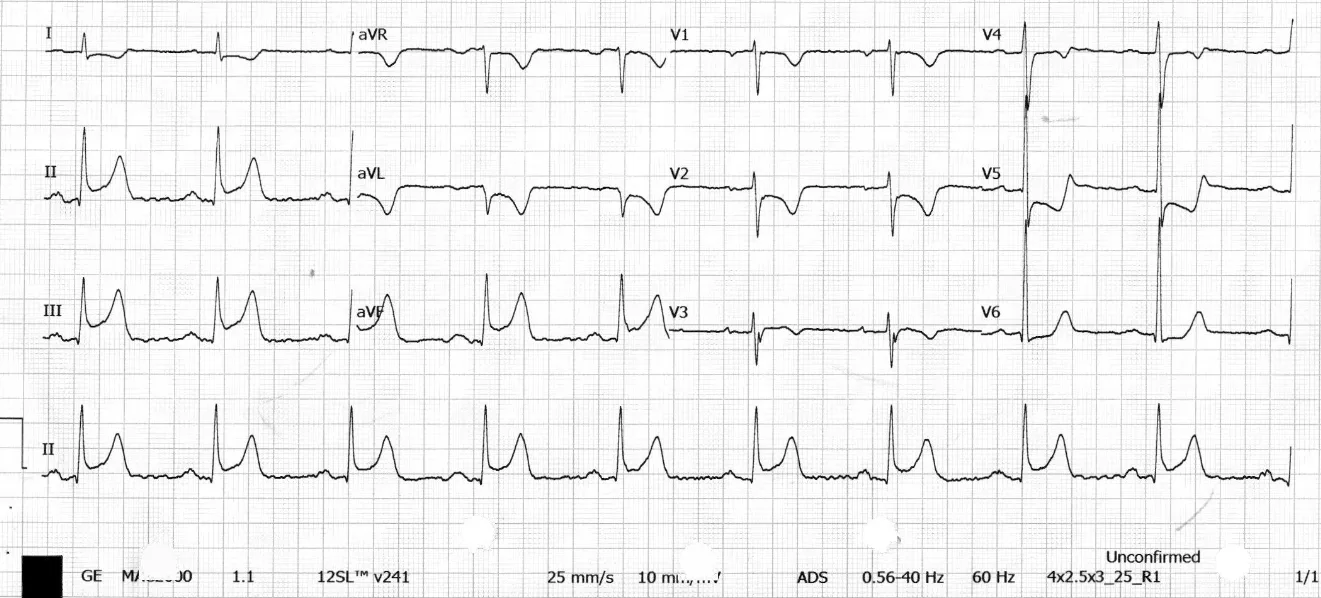
Is this Post. Wellens syndrome or De Winter?
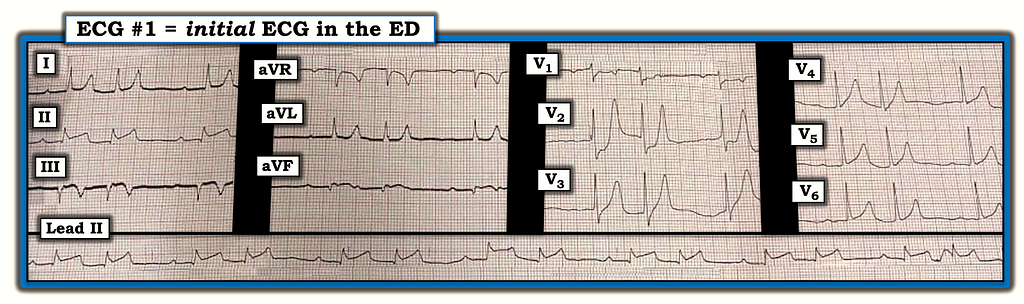
The latest ECG blog¹ posted an ECG. The ECG seems to show STE in the Inf. wall, plus STD and large T waves in V2~V3. But Ken Grauer felt V2~V3 looked like reperfusion after a Post.wall MI, which is why the T waves are tall.
When we used to learn ECG, diagnosing a Post.wall MI required a few conditions:
1.R/S>1 in V1 or V2 (i.e., Tall RV1) 2.STD in V1~V3 3.Upright T waves in V1~V3
Actually, the third point — Upright T waves in V1~V3 — isn't a necessary condition. Why?
Because if there are Upright T waves, it means the Post.wall is showing a reperfusion rhythm: Terminal T wave inversion, so Upright T waves appear in V1~V3 (the mirror image of the Post.wall). Of course, could the Post.wall still be in the middle of a myocardial infarction? Of course!!! And in that case, of course there are no Upright T waves.
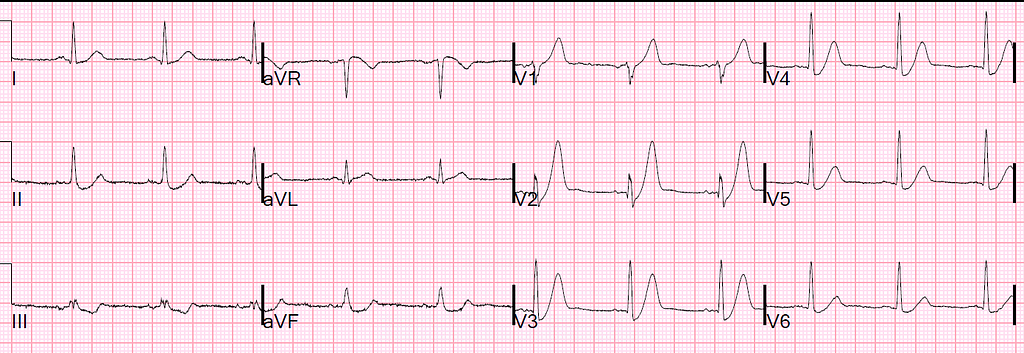
Also, in Ken Grauer's ECG, could V2~V3 be De Winter’s T waves?
So is this tracing actually a wraparound LAD, rather than an Inf. wall MI + Post.wall MI caused by an RCA problem?
So I wrote an email to Ken Grauer to ask. He said he felt the STD in V2 was flat, and he still felt it looked more like the patient had an Inf. wall MI + Post.wall MI, with the Post.wall in the process of reperfusing. He also felt that if these were De Winter’s T waves, they should involve more precordial leads, and would be less likely to be limited to V2~V3.
Conclusion:
Drawing on a Smith ECG blog post from a while back on how to tell De Winter’s T waves from the ST depression of a Post. Wall MI², plus Ken Grauer's reply
1.How to tell De winter's T waves from Post. Wellens' syndrome ➡ De winter's T waves may evolve from Hyperacute T waves, so the T waves are broad and fat, whereas the Tall T waves from the reperfusion rhythm of a Post.wall MI are the Post.wall's Terminal TWI, so they're narrower 2.If it's De winter's T waves, more Precordial leads are involved
- ECG Interpretation: ECG Blog #232 (47) — What is Bigeminy? — link
- Dr. Smith’s ECG Blog: De Winter’s T-waves are Not a Stable ECG condition. Upright T-waves in Posterior OMI are Distinct from de Winter’s waves. — link
Thoughts on this case? Leave a comment, a like, or a reaction below.
comments powered by Disqus